Google Ads vs Meta Ads for Local Businesses: Where Your First Budget Should Go
Google Ads reaches people who are already searching. Meta Ads reaches people who haven't started looking yet. Here's how they compare on cost and fit, and where a local business should start.

For most local service businesses, Google Ads is the better first choice, because it shows your ad to people who are already searching for what you do, often when they need it now. Meta Ads (Facebook and Instagram) are better at creating demand: reaching people who aren't searching yet but would be interested, which suits visual, impulse or local-event offers. Meta leads are usually cheaper, Google leads usually show stronger intent, and many businesses end up using both.
Key takeaways
- Google Ads captures existing demand. Meta Ads creates new demand.
- Benchmarks: Google search ads averaged $5.42 per click and $66.69 per lead in 2026. Facebook lead campaigns averaged $1.92 per click and $27.66 per lead in 2025.
- Urgent, high-intent services usually do better on Google first.
- Neither works without good tracking and a page built to convert.
What's the real difference between them?
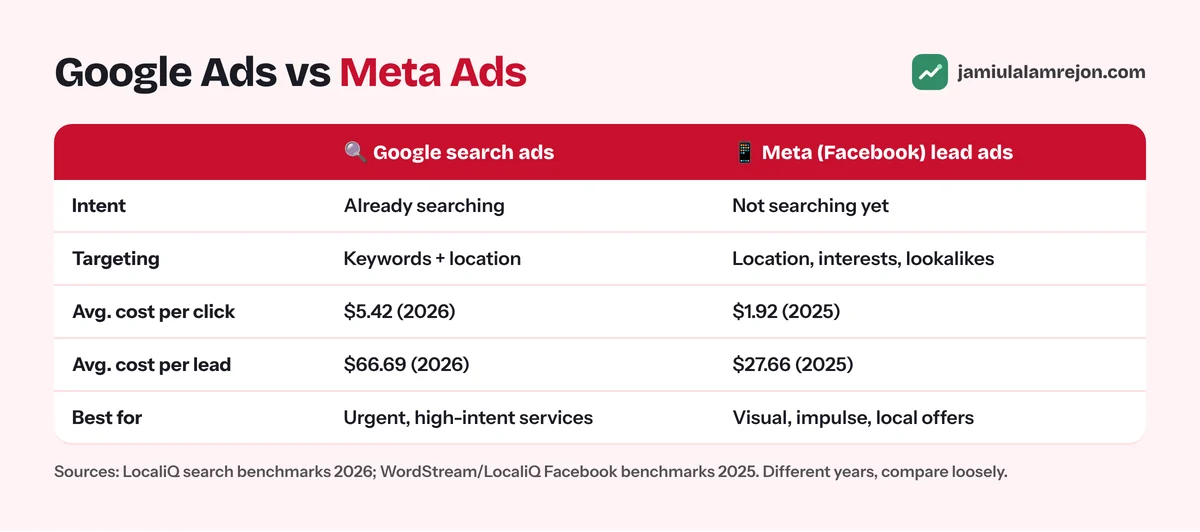
Google Ads (search) shows your ad when someone types a search: "emergency electrician near me", "teeth whitening cost Sydney". You're answering a question they've already asked. The intent is high, and so is the price per click.
Meta Ads show your ad in Facebook and Instagram feeds, stories and reels, to people chosen by location, interests, behaviour and similarity to your existing customers. They weren't searching. You're interrupting their scrolling, so the ad needs to catch attention, but clicks are much cheaper.
How much do they cost?
Benchmarks vary a lot by industry and location, so treat these as a rough guide, not a quote.
| Google search ads (2026) | Facebook lead ads (2025) | |
|---|---|---|
| Average cost per click | $5.42 | $1.92 |
| Average click-through rate | 6.64% | 2.59% |
| Average conversion rate | 8.18% | 7.72% |
| Average cost per lead | $66.69 | $27.66 |
Sources: LocaliQ search advertising benchmarks for Google, and WordStream/LocaliQ Facebook benchmarks reported by Search Engine Land for Facebook. The two sets cover different years, so compare them loosely.
Cheaper leads don't automatically mean better value. A $66 lead from someone searching "boiler broken no hot water" may be worth far more than a $28 lead from someone who tapped an ad between videos. What matters is your cost per paying customer. My ROAS calculator helps you work out whether a campaign is actually making money.
Which should a local business start with?
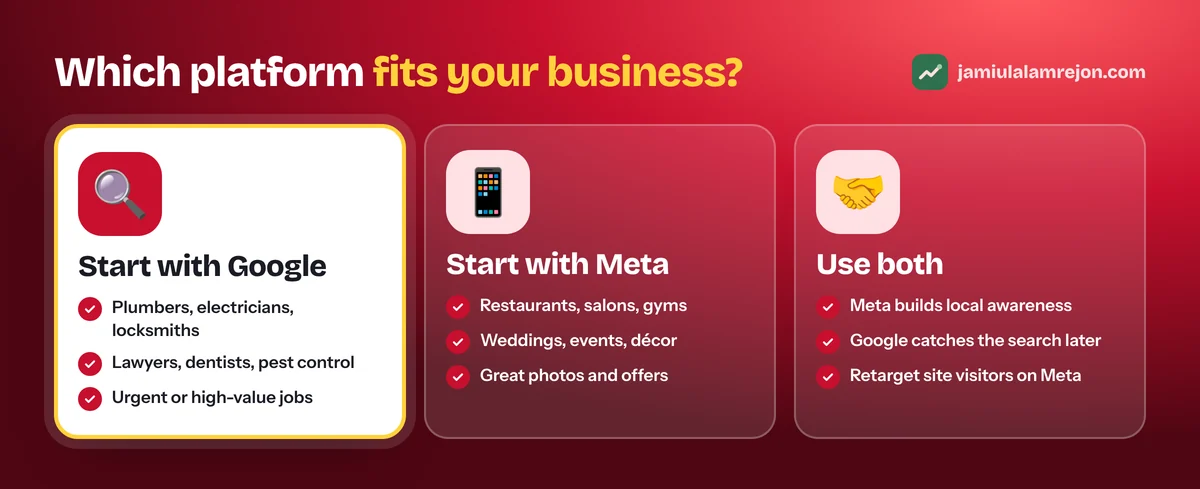
Start with Google Ads if:
- People search for your service when they need it: plumbers, electricians, locksmiths, lawyers, dentists, garage door repair, pest control.
- Jobs are urgent or high value.
- You can answer the phone quickly when leads come in.
Start with Meta Ads if:
- Your offer is visual or sold on emotion: restaurants, salons, gyms, wedding services, home décor, events.
- People don't usually search for it, but would buy if they saw it.
- You have strong photos or short videos, and an offer that makes people stop scrolling.
Use both when:
- You've got one working and want more volume.
- You want Meta to build awareness locally and Google to catch people when they search later.
- You want to retarget website visitors on Meta after they found you through Google.
What makes either platform work?
The platform matters less than these four things:
- Tracking that works. Conversions set up properly in Google Ads and in Meta, ideally with server-side tracking, so each platform learns from real results. I explain why in why your Meta Ads cost per purchase is high. The tracking fixes apply anywhere.
- A landing page built for the ad. One message, one offer, one action, and fast on mobile. The principles in the landing page that sells apply to both platforms.
- Fast follow-up. Leads cool quickly. See lead follow-up automation.
- Enough budget to learn. Spreading a small budget across many campaigns means none get enough data. Start focused.
Common mistakes on Google Ads
- Using broad match keywords with no negative keywords, and paying for irrelevant searches.
- Sending every ad to the homepage.
- Leaving the location setting so ads show to people outside your area.
- Not tracking calls, so the best leads are invisible.
Common mistakes on Meta Ads
- Boosting posts instead of running proper campaigns with a clear objective.
- Weak creative: a stock photo and a paragraph of text.
- Targeting too narrowly, which limits Meta's ability to find buyers.
- No pixel or Conversions API, so the algorithm optimises for the wrong people.
A simple first month on Google Ads
If you're starting Google Ads for a local service business, keep the first month simple:
- One campaign, one service. Pick your most profitable or most-searched service.
- A tight location. Target the area you actually serve, set to people in that location, not people "interested in" it.
- A short list of specific keywords. "Emergency plumber Leeds", "boiler repair Leeds", in phrase or exact match. Avoid single broad words like "plumber".
- A negative keyword list. Add "jobs", "salary", "course", "training", "free", "DIY" and anything else irrelevant you see in the search terms report.
- Call tracking and form tracking, tested before launch.
- One landing page for that service with a call button and a short form.
- Check the search terms report weekly and add new negatives.
After a month, you'll know your real cost per lead and which searches bring customers. Then expand.
A simple first month on Meta Ads
- One campaign with a clear objective, usually Leads (instant form or website) or Sales if you sell online.
- Broad targeting within your area. Let Meta find the people. Over-narrow interest targeting usually limits results.
- Three or four creatives. Real photos or short phone videos of your work, team or product, each with a different angle: a before-and-after, a customer quote, an offer.
- A clear offer. "Free quote within 24 hours", "First class free", "10% off your first booking". Something worth stopping for.
- Pixel and Conversions API installed and tested, so Meta learns from real leads. My Facebook Pixel setup and fix service covers this.
- Fast lead follow-up. Instant form leads go cold especially quickly.
Give Meta at least a week or two before judging creative, and change one thing at a time.
How do you decide which is working?
Don't compare platforms on cost per click or even cost per lead. Compare them on cost per customer, and ideally on profit.
For each platform, track for a month:
- Leads.
- Leads that you spoke to.
- Leads that became paying customers.
- Revenue from those customers.
Then divide spend by customers for each one. That number, and the revenue behind it, tells you where the next pound, dollar or euro should go.
Frequently asked questions
How much should a local business spend on ads to start?
Enough to get meaningful data in a month. A useful starting point is to estimate your target cost per lead and budget for at least 20 to 30 leads. With very small budgets, focus on one platform and one service.
Are Facebook ads cheaper than Google ads?
Per click and per lead, usually yes. Per paying customer, it depends on your business. High-intent Google leads often convert to sales at a higher rate.
Can I run Google Ads without a website?
You can run some call-only campaigns, but you'll get better results, and better tracking, with a fast landing page.
How long until ads work?
Google search campaigns can bring leads in the first days. Both platforms usually need a few weeks of data to settle and improve.
Should I hire someone or run ads myself?
You can learn the basics yourself. Get help with tracking setup and landing pages at least, because that's where most self-run campaigns waste money.
Want ads that you can measure?
I set up tracking, landing pages and campaigns that show you exactly what each lead costs. Look at my server-side tracking service or get in touch.