What Is Answer Engine Optimization (AEO)? A Plain Guide for Small Businesses
More searches now end with an answer, not a list of links. Here's what answer engine optimization is, how it relates to SEO, and the work that actually makes your content the answer.

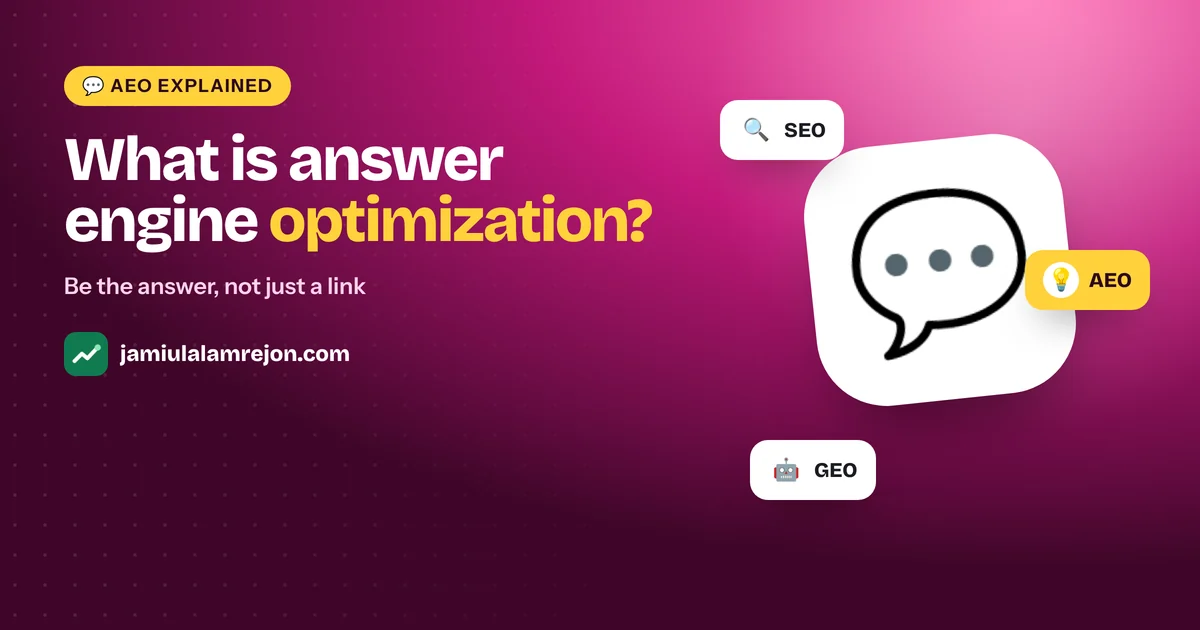
Answer engine optimization (AEO) is the work of shaping your content so a search engine or AI assistant can lift it as the direct answer to a question. Classic SEO is about ranking in a list of links. AEO is about being the text that gets read out, quoted in an answer box or summarised by an AI. It isn't a separate discipline from SEO. It's SEO written for the way people now ask questions.
Key takeaways
- AEO is about being the answer, not only being on page one.
- Google says optimising for its AI features "is still SEO". There's no secret AEO markup.
- What works: a clear question, a short direct answer near the top, real detail underneath, and a site people already trust.
- You measure AEO through impressions, AI-feature appearances and enquiries, not just clicks.
Why are people talking about AEO now?
Because searches end differently than they used to. Google's AI Overviews reached 2 billion monthly users across 200 countries and territories, Sundar Pichai told investors in July 2025 (TechCrunch). ChatGPT is close to a billion weekly users, according to OpenAI figures reported in July 2026 (The Next Web).
So a customer who used to type "plumber cost to fix leaking tap" and scroll through ten blue links now often gets a paragraph at the top of the page, or asks an assistant and gets one reply. If your page is the source of that paragraph, you're in front of them. If it isn't, ranking fifth doesn't help much.
That's the whole reason AEO exists as a term. The goal moved from "be on the list" to "be the answer".
How is AEO different from SEO and GEO?
You'll see three acronyms thrown around. They overlap a lot, and honestly the people selling them separately make them sound more different than they are.
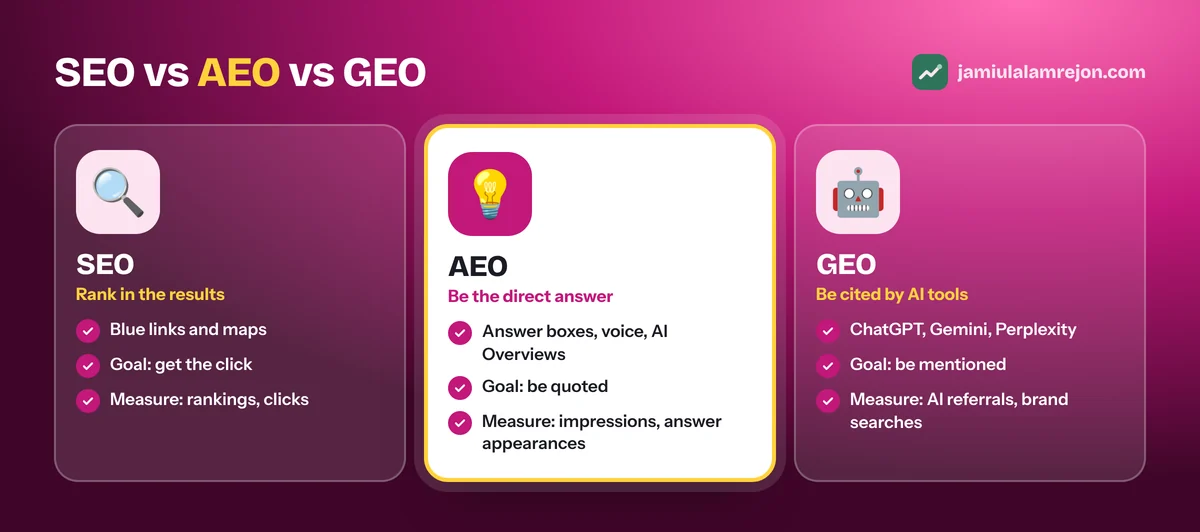
- SEO (search engine optimization) is about getting a page to rank and get clicked in normal search results.
- AEO (answer engine optimization) is about getting a page picked as the direct answer: answer boxes, voice answers, AI Overviews, "People also ask".
- GEO (generative engine optimization) is about getting your brand mentioned or cited when an AI tool writes a response, in ChatGPT, Gemini, Perplexity or Google's AI Mode. I've written a separate guide on getting recommended by AI tools.
Google's own position, in its guide on generative AI features published in May 2026, is that "optimizing for generative AI search is optimizing for the search experience, and thus still SEO" (Google Search Central). The same guide says you don't need special schema, llms.txt files or content chopped into small chunks for Google's AI features.
So treat AEO as a way of writing and structuring pages, built on top of normal SEO, not a replacement for it. If your site has technical problems, fix those first. My technical SEO checklist covers the basics.
How does a search engine choose which answer to show?
Nobody outside Google or OpenAI knows the exact rules, and anyone who says otherwise is guessing. But the pages that get picked share some things you can see for yourself.
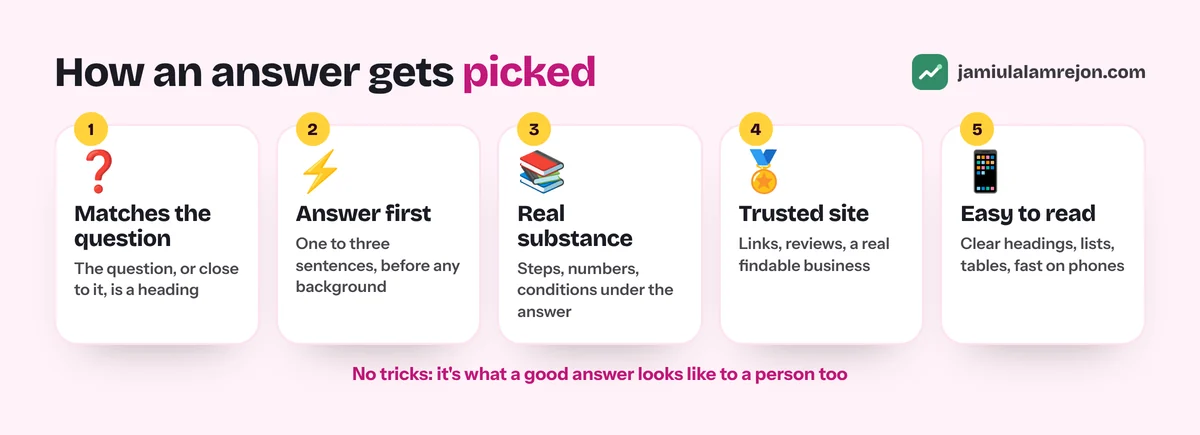
- The page clearly matches the question. The question, or something very close to it, appears as a heading.
- The answer comes first. One to three sentences that answer the question directly, before any background.
- The page has real substance underneath. Steps, numbers, examples, conditions. The short answer is the door; the detail is why the page deserves to be trusted.
- The site is trusted on the topic. Other sites link to it, the business is real and findable, and the content isn't thin or copied.
- The page is easy to read for people and machines. Proper headings, short paragraphs, lists where things really are lists, tables for comparisons, and a page that loads fast.
Notice that none of this is a trick. It's what a good answer looks like to a human reader too.
What does an AEO-friendly page actually look like?
Take a question a real customer asks you. Say you run a cleaning company and people keep asking "How long does an end of tenancy clean take?"
A page that is likely to be picked looks like this:
- Heading: "How long does an end of tenancy clean take?"
- First paragraph: "Most end of tenancy cleans for a two-bedroom flat take one team of two cleaners five to seven hours. Larger homes, heavy limescale or a dirty oven add time." (Use your real numbers, not mine.)
- Then the detail: a small table by property size, what's included, what slows a job down, and what the customer should do before you arrive.
- Then a call to action: how to get a quote.
Compare that with the typical service page that opens with "Welcome to ABC Cleaning, your trusted partner for all your cleaning needs." There's nothing in that sentence an answer engine can use.
Which questions should you write answers for?
Start with the questions your customers already ask you. They're better than any keyword tool because they're real, and they come with the words people actually use.
Good places to find them:
- Your inbox, WhatsApp and phone calls. Write down every question you hear more than twice.
- Google's "People also ask" boxes for your main service plus your town.
- Google Search Console, under Performance, filtered for queries containing "how", "what", "why", "cost" or "best". My Search Console guide shows where to look.
- Reviews of you and your competitors. People often mention the thing they were worried about before booking.
Group the questions by topic. Some deserve a full article. Many are better answered in one section of an existing service page.
The AEO checklist for each page
When I optimise a page for answers, I go through the same list every time.
- Put the main question in a heading, worded the way a customer would say it.
- Answer it in the first 40 to 60 words, in plain language, with no warm-up.
- Add the detail right after: numbers, steps, conditions, exceptions.
- Use a table when you compare options or prices, and a numbered list when order matters.
- Name your sources when you quote a figure, and link to them.
- Show who wrote it and why they know: your name, your role, your experience with the topic.
- Keep the page up to date and change the date only when you've changed the content.
- Make sure the page loads fast and reads well on a phone. Many of these questions are asked on one.
- Link to the related service page so a reader who gets the answer can take the next step.
Does structured data (schema) help AEO?
It helps search engines understand what a page is about, and it can make you eligible for some rich results. It is not a switch that makes you the answer. Google says plainly that structured data "isn't required for generative AI search" (Google Search Central).
One change worth knowing: Google stopped showing FAQ rich results in Search on 7 May 2026 (Search Engine Journal). FAQPage markup won't hurt you, but it won't produce those expandable questions under your listing any more. The questions and answers on the page itself still matter, because that's what gets read and quoted. I cover which schema types are still worth adding in schema markup for small business websites.
How do you measure AEO?
This is the awkward part. When your answer is shown directly, some people get what they need and never click. So clicks alone will undersell the work.
Watch these instead:
- Impressions in Search Console for your question-type queries. Rising impressions with flat clicks often means you're being shown as an answer.
- The Generative AI performance report in Search Console, which Google points to for measuring visibility in its AI features.
- Branded searches. If more people search your business name, more people are hearing about you somewhere.
- Enquiries and where they came from. Add "How did you hear about us?" to your contact form and include "ChatGPT / AI assistant" as an option.
Common AEO mistakes
- Writing for the machine. Stuffing the same question five ways into a page makes it worse for people, and Google says its systems already understand synonyms.
- Answering without substance. A two-line answer with nothing under it gives no reason to trust the page.
- Hiding the answer. Long introductions, sliders and pop-ups before the first useful sentence.
- Chasing every acronym. Paying for "AEO", "GEO" and "SEO" as three separate packages when they're mostly the same work.
- Ignoring the business basics. A real address, a complete Google Business Profile, reviews and a site that works. Those are part of trust.
A before-and-after example
Here's the kind of rewrite I do on client service pages. The business is a fictional dog groomer.
Before:
Welcome to Paws & Co! We are a passionate team of pet lovers dedicated to providing the highest quality grooming services in a relaxing environment. Your furry friend deserves the best, and that's exactly what we deliver.
Nothing in that paragraph answers a question. An answer engine can't quote it, and a customer learns nothing they can act on.
After:
How much does dog grooming cost in Brighton?
A full groom at Paws & Co costs £45 for small dogs, £55 for medium and £70 for large breeds, including bath, cut, nails and ears. Matted coats or anxious dogs may need extra time, and we'll tell you before we start.
Then the page goes on with a price table by breed, how long a groom takes, how often different coats need one, and how to book.
The second version answers the question people actually type, in the first two sentences, with numbers. It's also more useful to a human reader, which is the point: in AEO, the version that helps the reader is usually the version that gets picked.
Where AEO fits in your marketing
AEO isn't a separate project with its own budget. It's a way of writing every page you already have:
- Service pages answer "what is it, what does it cost, how long does it take, who is it for".
- Location pages answer "do you cover my area, how quickly can you get here".
- Blog posts answer the wider questions people ask before they're ready to buy.
- Your Google Business Profile answers "are you open, where are you, what do others say".
If you work through those four in order, you've done most of the AEO work a small business needs.
Frequently asked questions
Is AEO replacing SEO?
No. AEO sits on top of SEO. Google says optimising for its AI features is still SEO, and a page that can't be crawled, indexed or trusted won't be picked as an answer anyway.
How long does AEO take to work?
It depends on how strong your site already is. On a site Google already trusts, a well-rewritten page can start appearing for answers within weeks. On a new site, expect months, because trust takes time to build.
Do I need an llms.txt file for AEO?
Not for Google. Google's guide says Search doesn't use llms.txt and that creating one will neither help nor harm your visibility in Google Search.
Can a small business compete with big brands for answers?
Often, yes. Answer engines want the most useful answer to a specific question. A local business that answers a specific local question clearly can beat a big site with a generic page.
What is the single most useful AEO change?
Rewrite the top of your main service pages so they answer the main customer question in the first two or three sentences, using the customer's own words.
Want your site set up for answers?
I rebuild and optimise business websites so they rank, get picked as answers and turn visitors into enquiries. If you'd like me to look at yours, see my web development service or get in touch.