Fake Orders and COD Returns: 9 Ways Bangladeshi Online Shops Cut Losses
Every returned cash-on-delivery parcel costs you twice: courier charges and wasted ad money. Here are 9 practical ways to filter fake orders before they ship.
Cash on delivery is how most people in Bangladesh prefer to buy online, and it isn't going away. But every online shop owner knows the other side: orders that are never accepted, numbers that don't answer, and parcels that come back with courier charges to pay.
Fake and refused orders hurt in three ways:
- You pay delivery and return charges for nothing.
- Your stock is locked in transit for days.
- Your ads learn from the wrong people, because every fake order is reported to Facebook as a "purchase".
You can't remove the problem completely, but you can cut it sharply. Here are nine practical steps, from simplest to most advanced.
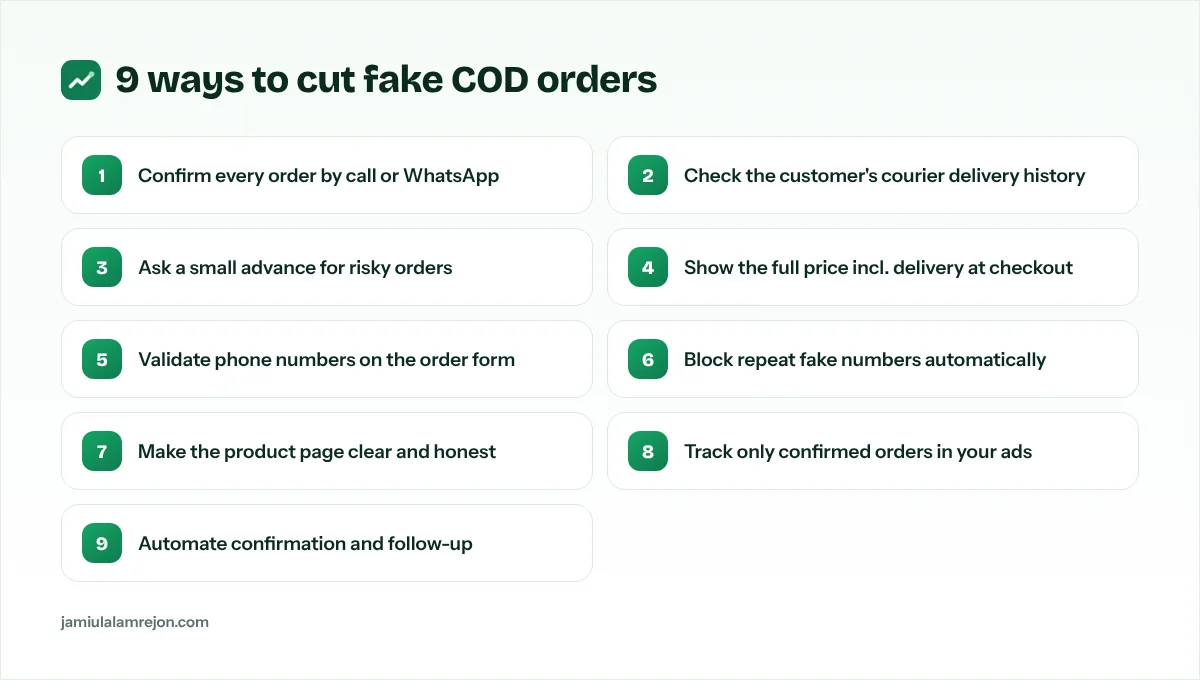
1. Confirm every order before shipping
A short call or WhatsApp message ("Assalamu alaikum, you ordered X for Y taka, delivery tomorrow, is that right?") filters a large share of fake and impulse orders. Orders that can't be confirmed don't ship. Simple, but only if someone does it consistently.
2. Check the customer's delivery history
Several courier fraud-checker tools let you check a phone number's past delivery success rate across couriers. A customer who refused most of their previous parcels is a high-risk order. Make this check part of your confirmation routine.
3. Ask a small advance for risky orders
For high-value items, new customers with poor history, or far-away areas, ask for the delivery charge in advance via bKash or Nagad. Real buyers usually agree; fake orders disappear. Explain it politely on the product page so it doesn't feel like distrust.
4. Show the full price at checkout
Many refusals happen because the customer was surprised by the delivery charge. Show the total including delivery before the order is placed, inside and outside Dhaka.
5. Validate phone numbers on the form
Your order form should reject incomplete numbers and obvious junk like "01111111111". A website form can check the format of a Bangladeshi mobile number instantly; a Messenger order can't.
6. Block repeat offenders automatically
Keep a list of numbers that refused or faked orders before. When the same number orders again, your system should flag it automatically instead of relying on someone's memory.
7. Make the product page honest and clear
Real photos, the real size, the exact colour and clear return rules reduce "it's not what I expected" refusals. Under-promise slightly and deliver what you showed.
8. Tell your ads which orders were real
If every order (including fake ones) is sent to Facebook as a purchase, the algorithm learns to find more people who order and refuse. Send purchases after confirmation, or mark confirmed orders separately, so your ads optimise for real buyers. See Facebook Conversion API for Bangladeshi shops for how this works.
9. Automate the boring parts
Steps 1 to 8 work, but they take time every day. With automation:
- New orders arrive in WhatsApp or a Google Sheet instantly.
- The customer's delivery history is checked automatically.
- A confirmation message is sent, and the reply updates the order status.
- Confirmed orders go to the courier automatically (see how).
- Repeat fake numbers are flagged before anyone wastes a call.
This is exactly the kind of workflow we build with AI automation and n8n.
Where to start
If you do nothing else this week, start with step 1 (confirmation) and step 8 (send only real purchases to your ads). Together they reduce wasted delivery charges and improve your ad results at the same time.
Frequently asked questions
Should I stop offering cash on delivery?
For most Bangladeshi shops, no: COD drives conversions. It's better to keep COD and filter risky orders with confirmation, history checks and small advance payments.
Is asking for an advance payment bad for sales?
Asking every customer can reduce orders. Asking only for risky orders (poor history, high value, far areas) usually protects you without hurting genuine buyers.
Can a website reduce fake orders compared to Messenger orders?
Yes. A website form can validate numbers, show full prices, record history and send data to your ads and courier automatically, which is hard to do with orders taken in chat.